Insurance exams test the law, so we put the law on every answer.
Insurance Pass prepares future producers and adjusters for their state licensing exams, with the statute behind each answer.
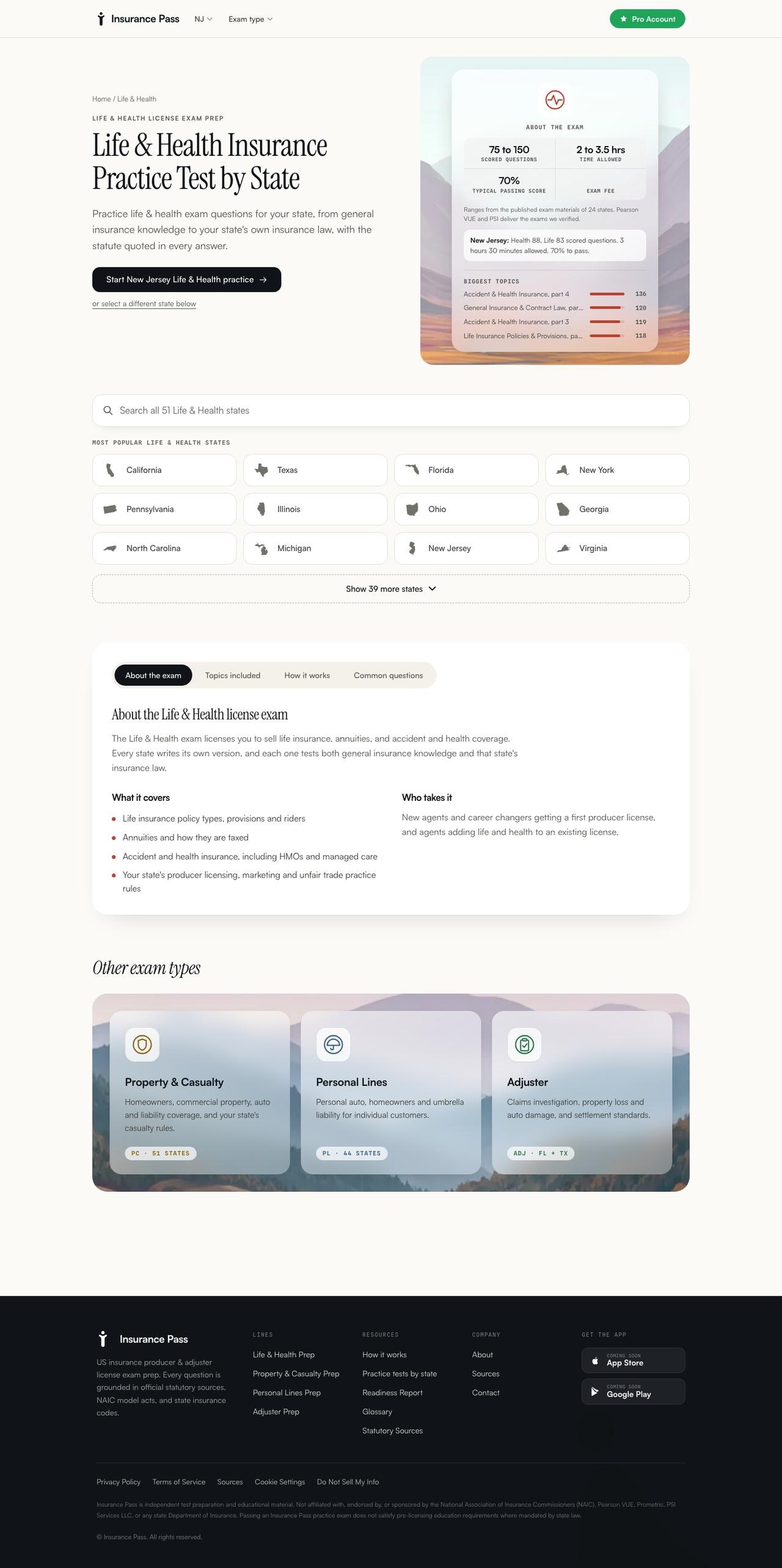
An insurance licence exam looks like a test of vocabulary and turns out to be a test of law. What counts as a covered loss, who can sell what, how a claim must be handled: the answers live in statutes and regulations, and those change when you cross a state line.
Most prep tools wave in that direction. We went and read the law.
Four lines of authority
Insurance Pass covers four lines of authority: Life and Health, Property and Casualty, Personal Lines, and Adjuster. You pick your state, pick your line, and practice what your exam actually covers, across the states and the District of Columbia.
Every answer shows its source
Questions are built from state statutes and regulations, and each answer quotes the provision behind it. That changes how studying feels. Instead of memorizing a result, you see the sentence of law that produces it, which is exactly what you need when the exam rewords the question.
Instead of memorizing a result, you see the sentence of law that produces it.
Treated like a future professional
People taking these exams are about to be licensed to give advice that affects other people's money and safety. The preparation should respect that. There are no trick questions and no hand-waving, just the rule and the reason it is the rule, and a readiness score that tells you when you are set for the proctor.
Who it is for
Insurance Pass is for people entering the insurance business: new agents and producers sitting a state licensing exam, professionals adding a second line, and claims adjusters who need their own licence.
What is inside
Four lines of authority. Life and Health and Property and Casualty are covered in all 50 states and the District of Columbia, Personal Lines in 44 states, and Claims Adjuster in the states that require its own exam. Every question is built from your state's statutes and regulations, and each answer shows the provision behind it.


